
A first-time cafe operator on a lean budget faces a flooring decision that can pass or fail a health inspection before the espresso machine is even plugged in. The wet zone behind a commercial coffee bar needs a finish that meets sanitation codes, survives dropped portafilters, and fits a tight renovation without replacing the subfloor. Sealed concrete costs less when the existing slab is flat and dry, while commercial sheet vinyl bridges uneven or damp slabs without expensive moisture mitigation. Both materials satisfy FDA Food Code requirements when installed with proper cove bases and slip-resistant surfaces. See also: low-budget cafe interior choices.
Contents
- What does the FDA Food Code require for floors behind a commercial coffee bar?
- Is sealed concrete suitable for wet zones behind espresso machines?
- Does commercial sheet vinyl meet health codes for coffee shop interiors?
- Sealed concrete vs. sheet vinyl: installed cost comparison for small cafes
- Slip resistance requirements for wet coffee bar floors
Key takeaways
- The FDA Food Code requires floors in food preparation areas to be smooth, durable, non-absorbent, and easily cleanable.
- Epoxy-sealed concrete withstands constant water exposure and dropped portafilters when applied over a structurally sound slab with proper moisture testing.
- Commercial-grade homogeneous sheet vinyl with heat-welded seams meets FDA Food Code requirements when installed with an integral cove base.
- For a typical 80 to 150 square foot coffee bar zone, epoxy-sealed concrete costs less if the existing slab is flat and dry.
- Both sealed concrete and sheet vinyl must provide adequate slip resistance in wet conditions to comply with OSHA recommendations.
- FDA Food Code Chapter 6 requires floors in food preparation areas to be smooth, durable, non-absorbent, and easily cleanable, with a coved wall junction of at least 4 inches.
- Epoxy-sealed concrete requires an ASTM F1869 moisture test over a 60 to 72 hour period before application to prevent delamination.
- Commercial sheet vinyl requires a subfloor flatness tolerance of 3/16 inch in 10 feet, achieved through self-leveling underlayment when retrofitting older spaces.
- Both finishes must achieve a dynamic coefficient of friction (DCOF) of 0.42 or higher on wet surfaces to reduce slip hazards during service.
What does the FDA Food Code require for floors behind a commercial coffee bar?
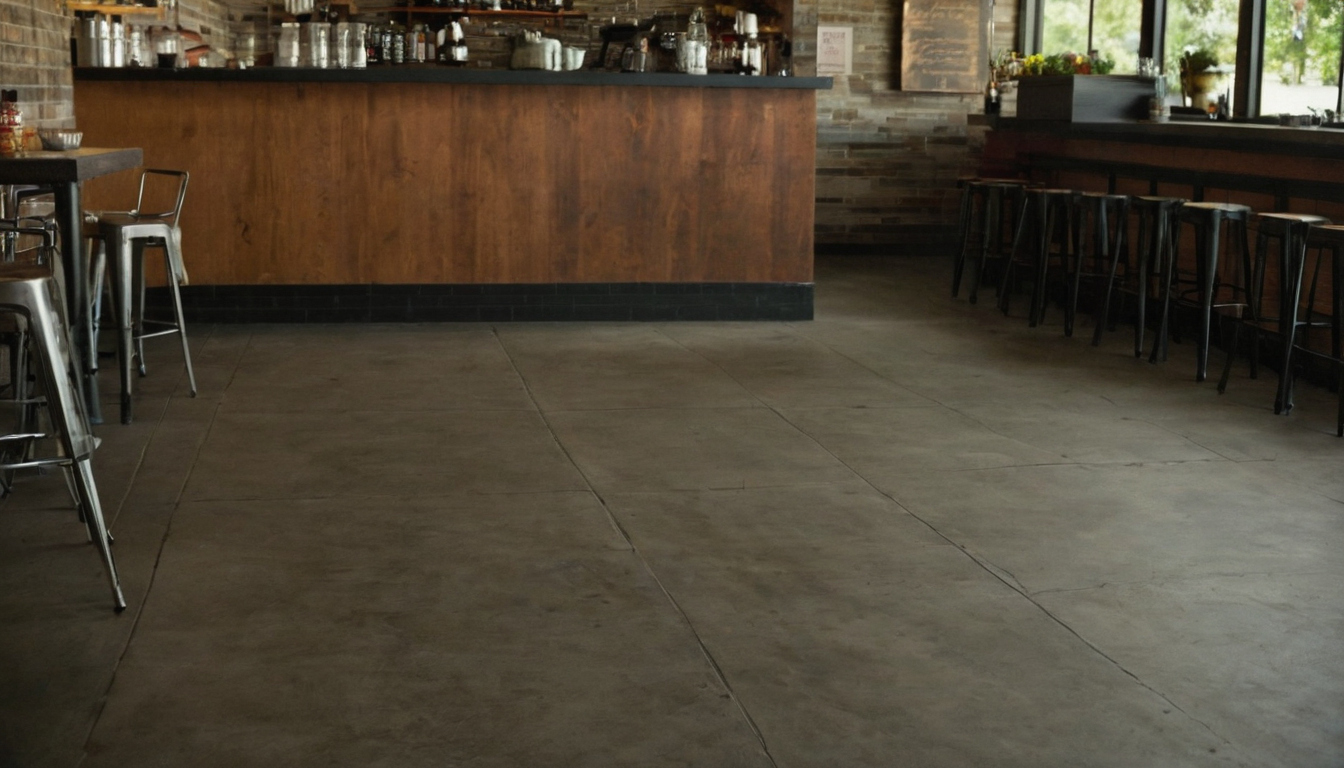
The FDA Food Code requires floors in food preparation areas to be smooth, durable, non-absorbent, and easily cleanable. Behind a commercial coffee bar, that means sealed concrete or commercial sheet vinyl with integral cove bases that eliminate gaps where moisture and coffee grounds collect.
Health inspectors evaluate the wet zone behind your espresso machine as a food preparation surface. Chapter 6 of the FDA Food Code mandates floor finishes that resist liquid penetration and allow routine sanitation without trapping debris. Unsealed grout lines, cracked tiles, and raw wood fail this standard immediately. A first-time operator making low-budget cafe interior choices must fund the floor finish before decorative elements, because an inspector can halt operations over porous flooring.
Cove bases form the critical junction between the floor and the wall. Local health departments typically enforce a minimum cove base height of 4 inches to prevent water from pooling at the perimeter during mopping or equipment washdowns. The transition must curve upward smoothly rather than meet the wall at a sharp ninety-degree angle. Sheet vinyl achieves this through heat-welded integral coves, while sealed concrete requires a formed epoxy or cementitious cove applied before the final topcoat.
Abrasive cleaning methods damage compliant surfaces. The Natural Stone Institute warns that scouring powders or creams scratch stone surfaces because those products contain abrasives. The same mechanical damage affects epoxy coatings and vinyl wear layers behind a coffee bar. Scrubbing dried milk residue with harsh compounds dulls the finish, creating microscopic grooves where bacteria colonize. Stick to neutral pH cleaners approved for commercial food-service floors.
Moisture management determines whether a floor stays compliant after opening day. The U.S. Environmental Protection Agency states that wet or damp spots should be fixed promptly to prevent mold growth. Condensation from refrigeration units and runoff from three-compartment sinks create persistent damp zones. A floor material must tolerate daily wetting without degrading or harboring biological growth beneath its surface.
Code requirements narrow your options to two viable materials. Next, determine whether sealed concrete can survive the constant moisture and thermal shock directly under your espresso machine and drip trays.
What does the FDA Food Code require for floors behind a commercial coffee bar.
Is sealed concrete suitable for wet zones behind espresso machines?
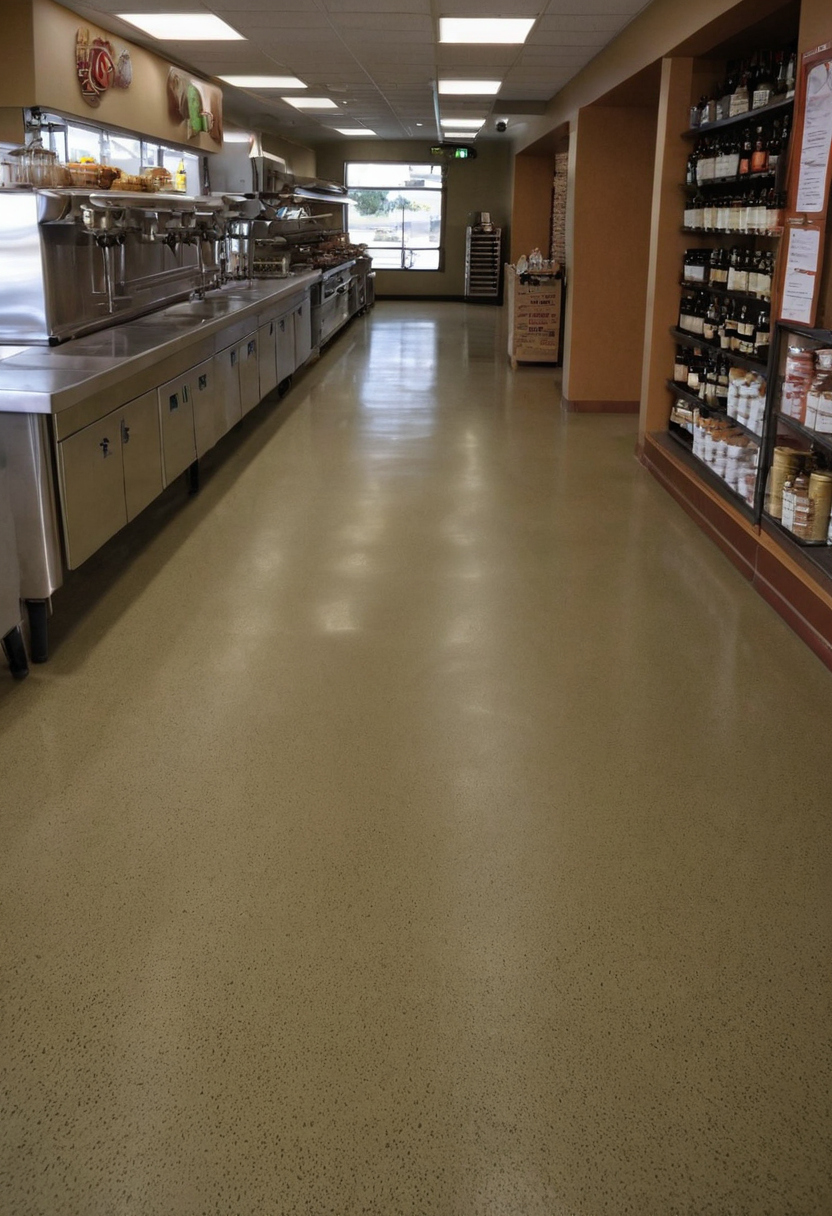
Epoxy-sealed concrete withstands constant water exposure and dropped portafilters when applied over a structurally sound slab with proper moisture testing. For small cafe builds, it eliminates the need for additional underlayment but requires professional surface preparation to meet health code smoothness standards.
A 100% solids epoxy coating bonds directly to the concrete substrate, creating a seamless surface with no gaps for spilled milk or coffee oils to collect. That seamlessness is exactly what local health inspectors look for during a first walk-through. The finish also resists the acidic pH of espresso waste, which degrades unsealed grout within months of opening day.
Is sealed concrete suitable for wet zones behind espresso machines.
Choosing epoxy-sealed concrete for your wet zone depends on five conditions you can verify before committing your renovation budget:
- Slab moisture. ASTM F1869 measures the moisture vapor emission rate (MVER) from a concrete subfloor using anhydrous calcium chloride over a 60 to 72 hour test period. This test is required before installing moisture-sensitive floor coverings like 100% solids epoxy systems on concrete slabs, and results are reported in pounds per 1,000 square feet per 24 hours (ASTM International). A reading above the epoxy manufacturer’s stated limit means moisture will eventually push the coating off the slab.
- Surface profile. Concrete must be mechanically ground or shot-blasted to open the pores. A smooth, troweled slab prevents the epoxy from anchoring properly, leading to peeling under heavy equipment legs.
Installed costs for epoxy-sealed concrete in US commercial applications generally range from $5 to $12 per square foot, depending on surface preparation, the number of coats, and regional labor rates. For an 80 to 150 square foot wet zone behind a compact coffee bar, total flooring investment often lands between $400 and $1,800. That price assumes an existing slab in reasonable condition. If the concrete requires extensive crack repair or leveling, preparation costs add to the final figure.
The primary risk with sealed concrete is the substrate beneath it, not the material itself. A hairline crack in the slab will telegraph through the epoxy within a year of thermal cycling. Inspect the concrete for structural movement before choosing this path. If the slab shifts seasonally, the rigid epoxy shell fractures along the fault line, exposing raw concrete to standing water.
Moisture mitigation primers can address moderate vapor transmission issues, adding roughly $2 to $4 per square foot to the project cost. These primers seal the pores before the main epoxy body coats go down. Skipping a primer on a marginal slab saves money during the build but guarantees a failed inspection or a delaminated floor within the first year of service.
Sealed concrete delivers a monolithic, washable surface that handles hot water, dropped tools, and chemical cleaners without degrading. Yet not every lease space has a pour-ready slab in acceptable condition. When the concrete underneath fails the moisture test or shows structural cracking, operators need a material that bridges those imperfections rather than mirroring them. Does commercial sheet vinyl meet health codes for coffee shop interiors when the slab falls short of epoxy requirements?
Does commercial sheet vinyl meet health codes for coffee shop interiors?
Commercial-grade homogeneous sheet vinyl with heat-welded seams meets FDA Food Code requirements when installed with an integral cove base. Unlike luxury vinyl plank, sheet vinyl prevents water from reaching the subfloor through seams, making it the safer choice for tight coffee bar renovations over existing slabs.
Health inspectors evaluating a coffee shop interior design look for three specific floor conditions behind the counter: a smooth surface without grout lines or gaps, non-absorbent material that resists coffee acids and cleaning chemicals, and a coved junction where the floor meets the wall. Homogeneous sheet vinyl satisfies all three. The color and pattern run through the entire thickness of the material rather than sitting on a printed layer, so dropped portafilters or dragged milk crates do not expose a different substrate underneath.
Seam treatment is the critical difference between commercial sheet vinyl and residential rolls. Installers join sheets using a heat weld that fuses the edges into a single continuous membrane. Water pooling under an espresso machine cannot seep through a welded seam to rot the subfloor or harbor bacteria. Residential click-lock planks or peel-and-stick tiles leave micro-gaps that fail sanitation inspections in food preparation zones.
An integral cove base curves the vinyl up the wall by four to six inches without a separate trim piece. This eliminates the sharp 90-degree corner where mop water and coffee grounds collect. Adhesive selection matters as much as the vinyl itself. Wet-area installations require moisture-curing urethane adhesives rated for high alkalinity and elevated moisture vapor emission rates. These adhesives typically need 24 to 72 hours to reach full cure before the floor can handle heavy equipment or standing water.
Commercial sheet vinyl for food service carries a total thickness between 2.0 and 3.0 millimeters, with a wear layer matching that full thickness in homogeneous products. Residential vinyl often measures under 2.0 millimeters total with a thin photographic wear layer that scuffs quickly under barista foot traffic.
Old cafe spaces rarely meet this tolerance without intervention. Retrofitting a slab requires a Portland cement-based or self-leveling underlayment before rolling out the vinyl. Leveling compound adds material cost and labor time to the project budget. A severely uneven slab might demand multiple pours, each requiring its own drying period of 12 to 24 hours depending on thickness and ambient humidity.
Leaving subfloor deviations uncorrected causes two operational problems. First, the vinyl stretches over dips and compresses over ridges, leading to premature wear at stress points. Second, heavy equipment like three-group espresso machines or refrigerated prep tables concentrates weight onto those raised spots, potentially cracking the leveling compound underneath and breaking the adhesive bond. When planning your build, measure the slab with a straightedge before ordering materials to know exactly how much leveling compound the space demands.
Those preparation steps lead to the final financial question: how does the total installed cost of sheet vinyl compare to sealed concrete when you factor in leveling compounds, adhesives, and welding labor for an 80-to-150-square-foot wet zone?
Sealed concrete vs. sheet vinyl: installed cost comparison for small cafes
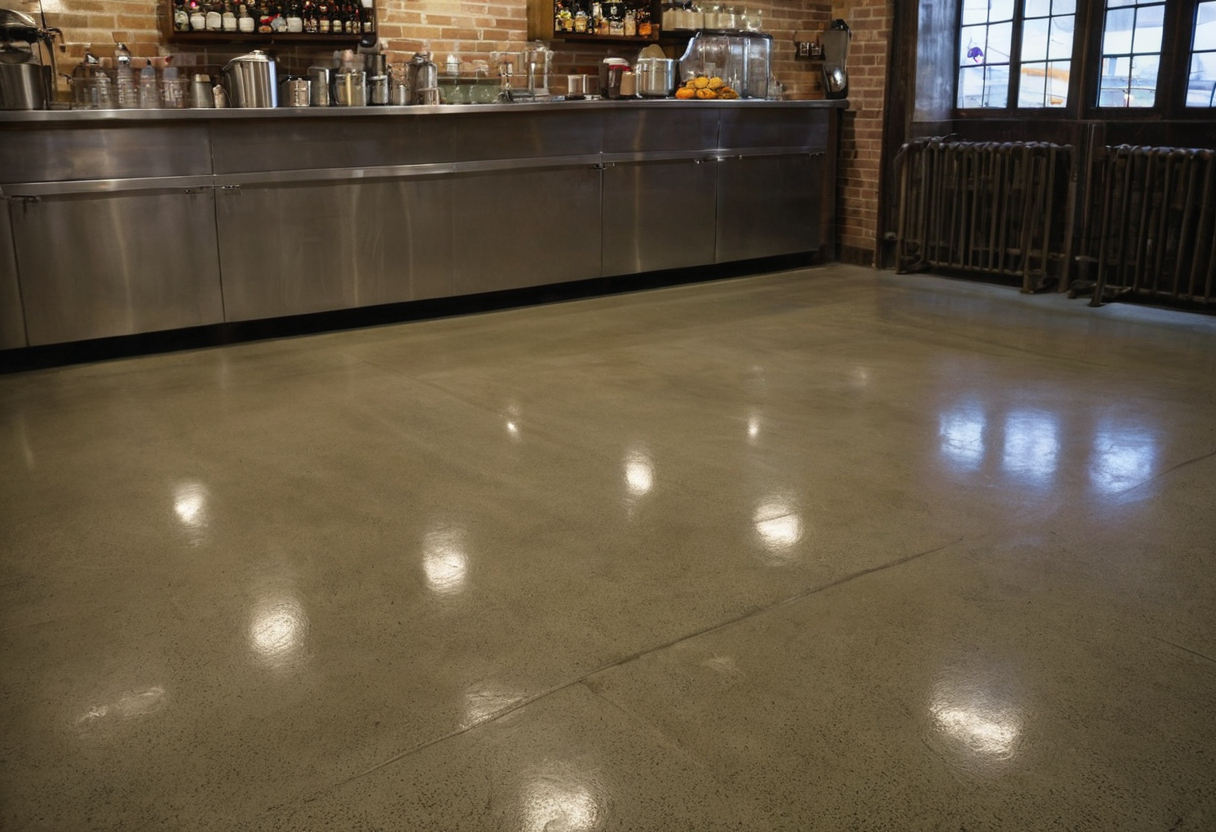
For a typical 80 to 150 square foot coffee bar zone, epoxy-sealed concrete costs less if the existing slab is flat and dry. Sheet vinyl costs more upfront but avoids expensive slab grinding or moisture mitigation, making it the practical choice for older buildings with uneven subfloors.
Installed pricing for behind-the-bar flooring depends on four line items: surface preparation, material, cove base integration, and labor. Epoxy-sealed concrete typically runs $4 to $7 per square foot installed when the slab needs only light diamond grinding and a standard two-coat 100 percent solids epoxy system. Commercial sheet vinyl with heat-welded seams and an integral cove base usually lands between $6 and $10 per square foot installed, driven by adhesive costs and the specialized welding labor required to meet health codes.
Moisture mitigation changes the math entirely. If the concrete slab emits moisture beyond what the epoxy manufacturer allows, you must install a moisture vapor barrier or a cementitious underlayment before coating. That remediation adds $3 to $6 per square foot to the project. In a 120 square foot espresso zone, that extra step can push the sealed concrete total past the cost of sheet vinyl, which often uses adhesives formulated to tolerate higher moisture levels without a separate barrier.
Sealed concrete vs. sheet vinyl: installed cost comparison for small cafes.
Lifespan expectations under daily commercial traffic also differ. A properly applied 100 percent solids epoxy floor behind a coffee bar lasts 7 to 10 years before requiring a recoat, provided staff avoid dragging heavy equipment across it. Commercial-grade sheet vinyl with welded seams holds up for 10 to 15 years in similar conditions, resisting coffee acids and repeated wet mopping without losing its seal at the edges.
Check these risks against your budget when evaluating your build:
Equipment weight introduces another constraint. A fully loaded two-group commercial espresso machine weighs 150 to 200 pounds, concentrated on four small leveling feet. Concrete handles this point load without indentation. Sheet vinyl resists the static weight well, but rolling heavy machines across it during installation or maintenance can tear the material or leave permanent depressions if the subfloor underneath flexes. Always use plywood sheets to distribute weight when moving equipment over fresh vinyl.
Floor thickness directly affects usable standing width in tight builds. Epoxy adds roughly 1/16 to 1/8 inch to the slab height. Sheet vinyl plus adhesive adds about 1/8 to 3/16 inch. That fraction of an inch matters when calculating clearances between counters and equipment. Review your small-space coffee bar layouts before ordering materials to ensure the finished floor height does not reduce your working aisle below the 36 inches most local codes require for staff passage.
Plan flooring alongside worktables and plumbing, since every dollar spent fixing a subfloor is a dollar pulled from equipment. Mapping out the broader plan early prevents a beautiful floor from forcing you to buy a cheaper, less reliable grinder.
A smooth, compliant floor only protects your operation if baristas can stand on it safely through a six-hour shift covered in spilled milk and rinse water. Next, verify that your chosen material meets slip resistance requirements for wet coffee bar floors.
Slip resistance requirements for wet coffee bar floors
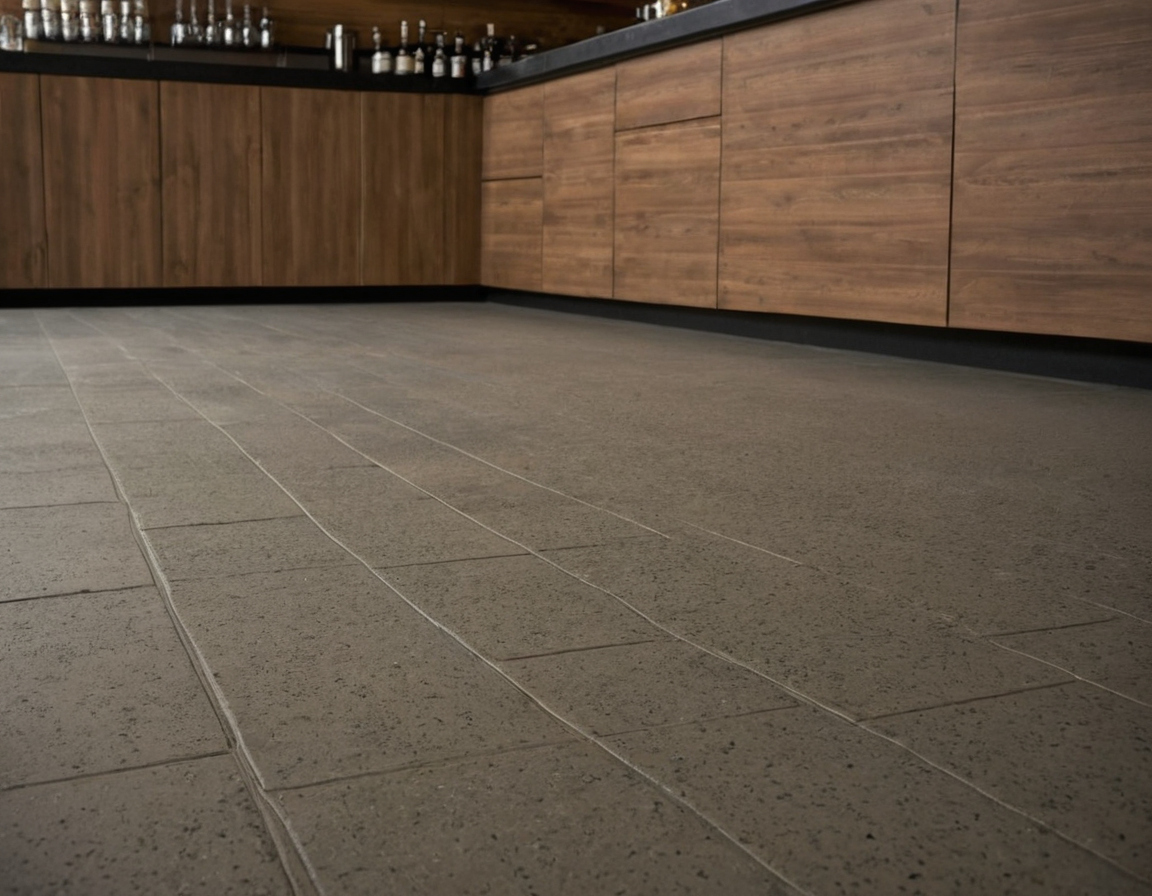
Both sealed concrete and sheet vinyl must provide adequate slip resistance in wet conditions to comply with OSHA recommendations. Textured epoxy additives or embossed vinyl surfaces reduce slip hazards from spilled milk and water without creating rough textures that violate smooth-surface sanitation codes.
A DCOF (dynamic coefficient of friction) of 0.42 or higher on wet surfaces is the benchmark most health inspectors and commercial flooring manufacturers reference for food preparation zones. A bare polished concrete slab rarely meets this threshold once a film of espresso syrup or steamed milk covers it. The floor finish behind your espresso machine needs built-in traction before opening day, not after a staff injury.
Textured epoxy coatings address this problem for sealed concrete floors. Installers broadcast fine aluminum oxide or silica sand into the wet epoxy layer to create a grit profile. The particles must be small enough that the surface remains easily cleanable under FDA Food Code standards. Coarse aggregates trap coffee grounds and milk fats, forcing baristas to scrub rather than mop. A light broadcast leaves enough texture for shoe grip while keeping the floor non-absorbent and smooth enough to pass inspection.
Commercial sheet vinyl gets its traction from factory-embossed patterns rather than field-applied grit. The texture is pressed into the wear layer during manufacturing, keeping the surface consistent across the entire installation. Embossed vinyl does not shed aggregate over time, making it a predictable choice for tight spaces where a dropped portafilter already risks damaging the floor.
Slip resistance requirements for wet coffee bar floors.
Daily cleaning protocols differ between the two finishes. Textured epoxy requires a neutral-pH cleaner to avoid breaking down the resin around the embedded grit. The Natural Stone Institute recommends cleaning natural stone surfaces with neutral cleaners, stone soap, or mild liquid dishwashing detergent and warm water, and the same principle applies to textured resin floors: harsh degreasers or acidic descaling solutions strip protective sealers and expose the aggregate to staining. Embossed vinyl tolerates standard commercial kitchen detergents but shows scuff marks faster under heavy foot traffic.
Choosing a floor finish based only on upfront cost overlooks how daily traction affects barista movement. A slippery floor forces staff to shorten their stride and move cautiously between the grinder station and the hand-wash sink. Specifying the correct DCOF rating and texture profile during the build phase is one of those cafe interior choices that protect speed behind the counter for years. Ask your flooring installer for a wet DCOF test result on the exact finish you plan to use, and write that number into your renovation scope before signing the contract.
For more on this topic, see other guides on this site.